Saturday, 13 October 2018
Salsa Shark's Back Slate: Enter the Dragon
One of the chief concerns of any film critic is always; Have I seen the essentials? Not just the classics or the tiresome '1000 Films to See Before You Die' but any film considered formative to the medium. With a keen enough mind, pretty much any film has the potential to widen our understanding of cinema. And while film is a relatively young medium it's one that has produced more work that is possible for any individual to see (in fact due to poor preservation there are some films that are simply not possible for anyone to see). So inevitably we all have our blind-spots, our films to put on the back slate to get around to some time. I've accrued more than my fair share over the years; essential films taking up space on the DVD shelf or the Netflix queue. So from time to time I'm going to recount my experiences crossing these off the list in whatever way I happen to (though preferably on the cinema screen).
With the anniversary of Bruce Lee's death coming up Watershed hosted a screening off Enter The Dragon, complete with introduction from Timon Singh. It's a film that's been on my hit-list for some time but circumstances have just got in the way. Arguably the seminal film of the late Bruce Lee's career Enter the Dragon has permeated the pop culture, even if only for Lee's involvement.
With the benefit of hindsight it's easy to see what a boost Lee's presence is to the film's legacy. Taken on it's own it's a fairly schlocky example of Kung fu-sploitation films that popped up during the 70s and 80s. It wastes time splitting the focus between multiple protagonists, none of whom possess Lee's charisma. The story is surprisingly bloated for what should be a simple martial arts tournament, layering multiple threads around not only Lee's character but also the supporting cast made-up primarily of Jim Kelly and John Saxon. Unfortunately the script never finds anything substantive for it's antagonist Han, leaving him with the one-note characterisation of a mere drug baron with a little Asian flair.
But then this is less a film about character and story and more about style and action and on that front the film 100% delivers. Lee is always a compelling screen presence and here his sense of calm as he approaches each new fight leaves you with a sense of confidence Even during the dialogue driven scenes he manages to invest pathos and even a little humour into the exchange. So much so that when it comes for him to throw down it feels like a shared victory as he takes out waves upon waves of bad guys.
The film's style definitely borrows more from the blaxsploitation genre than anything native to Chinese cinema. With Lalo Schifrin's score rich with elements of funk combined with Eastern string instruments. It's feels like the birth of its genre which speaks to much of the impact of Enter the Dragon. In the ends this is a film that is beloved as an artifact in the history of cinema. Not only as the Bruce Lee film but also the film that introduced the world to a rough, contemporary new version of martial arts film. One that aimed to break convention and define action cinema for decades to come.

Tuesday, 10 July 2018
The Tale
The Tale is that rare film that captures its subject matter so effectively that it entirely justifies putting a trigger warning up front. So for the benefit of those who may be sensitive to the subject this film does cover topic of grooming and child sexual abuse. While that might put some off I think it's important to note that it may be the best attempt to cover such material in a long time. In no small part due to the role of the film-maker behind it.
Said film-maker is Jennifer Fox, primarily a documentarian, who a few years ago underwent a reexamination of her childhood after her mother discovered a story she had written as a teenager. The story chronicled a summer she spent at riding camp under the keen tutelage of the glamorous and towering Mrs G. It would soon be revealed to Jennifer that Mrs G was engaged in an affair with Bill, the camp's riding instructor, an affair that they would bring the then thirteen-year-old into.
While much of the film is about romanticizing the past the film, sensibly, never tries to match the rose-tinted view Jennifer previously held towards her abusers. The Tale pulls no punches in the the grim kind of pressure placed on a young girl and the ugliness of her abuse. Event the scenes of Bill's attempts at 'courtship' are tainted with a strong sense of tension as you wait for the penny to drop. It's made clear from the start that Jennifer has tried to romanticize this, viewing Mrs G as a beautiful giant of a woman appropriately played by the 6ft 2in Elizabeth Debicki.
In effect Jennifer has rewritten this incident as an exciting, coming-of-age experience and only now, with the perspective of time can she see the abuse for what it really was. The creeping doubt that slowly consumes Laura Dern's performance as Jennifer is a subtle but powerful thing to watch. So much of her character is admirable; accomplished film-maker, respected educator, self-confident independent woman. And yet we are left to wonder how much of that came from this horrifying period in her life. After confronting both the event and her abusers we find Jennifer left, not broken, but certainly empty.
At it's core The Tale is a film about the unreliability of memory. About how our distorted view of the then influences our now. But does that mean the person we are now is any less real for being based on a falsehood? The answer is no. The forcibly mature 13-year-old Jennifer who sees herself as the hero of her tale is no less real than the shaken forty-something today.
It's the kind of perspective that could only come from having a director so close to the events of the film. Fox takes ownership of what happened even if she cannot bring her abusers to justice. All she can do is tell her story and she has done so powerfully.
Monday, 9 July 2018
Hereditary: An Frightening Lineage
Hereditary is one of those films that proves the ability of a talented director and cast to elevated a well-intentioned but ultimately flawed work. All the elements are in place for an atmospheric and gripping horror filled with sympathetic and complex characters. Everything except for the actual story which starts out from an interesting place but just can't quite bring itself to a satisfying conclusion. Unfortunately this means that any exploration of what's wrong with Hereditary means a discussion of events which occur late in the film. So if you want to go into the film as blind as possible then I would advise looking away now.
The plot of Hereditary focuses on miniatures artist Annie Graham as she attempts to process her mother's passing. Annie's mother, we are told, was a difficult and secretive woman who kept many friends and participated in activities that Annie was kept far away from. To compound the matter she showed an uncharacteristic affection for Annie's daughter Charlie, played by newcomer Milly Shapiro. Charlie is an awkward and vulnerable child who fears that now her grandmother is dead no one will be able to look after her. It a fear that is soon realized as tragedy continues to befall the Graham family, forcing Annie to try to communicate with ghosts in order to understand her grief. However by doing so finds herself falling deeper into a trap that her mother laid for her.
All of which comes together as really compelling, edge-of-your seat horror film stuff.The turns which this story take are really surprising and frightening and all the while you're heart is going out to this grieving mother and the family that is falling apart around her. But eventually the film reaches it's final act and feels the need to give all of these strange occurrences a very specific explanation that is neither satisfying or coherent. For one thing it falls into a lazy horror trope, for another it relies too much on contrivance and finally it just doesn't seem to have anything to do with what the film has presented itself as being about. From the start Hereditary is a film about Annie's grief over her mother and how that has led her to neglect her family to the point of self-destruction. But then to turn it around and say that this is all actually someone working behind the scenes. It just undermines what the rest of the film has been about.
The best horror films derive all their best moments from simple, but deep premises. A Quiet Place is about horror through silence, Get Out is about racial commodification, Drag Me to Hell is about being dragged to hell. But nothing in Hereditary is about what Annie is inheriting from her mother, she isn't a part of the conspiracy her mother is involved in, she doesn't even know about it until the very end. And once you start pulling at that thread the rest of the film starts to fall apart; the big scares and story points and especially the creepy iconography like the miniatures and the performances from Milly Shapiro and Alex Wolf as her older brother. These feel less like parts of a single, haunting idea and more like random elements thrown in to amp up the creep factor. It's a bit like the Annabel doll from The Conjuring, it has nothing to do with the rest of the film but it's creepy and iconic so why not throw it in.
This isn't to say that the film is a total bust. I think Ari Aster is a really effective director of horror, his sense of suspense is the reason I was on my seat so much throughout the film. And he gives the film a very unique visual aesthetic with the melding of Annie's miniatures with physical scenery. It all adds to the creepy vibe even if, ultimately it doesn't amount to anything. I can totally see this guy going on the payroll at Universal if they ever try that Dark Universe again.
Toni Collette is also a big part of why this film works. I know 'barely-together mom' is pretty much her bread-and-butter but she always finds a new twist to take on it and this is no exception. Annie is a detached, career-focused mother and we haven't really seen that done with the more kooky artist type. She brings real believably to some of the bigger leaps of logic her character makes and more importantly she's someone you can invest in emotionally. When things start going wrong for her it's not just frightening it's outright heart-breaking. Like I said there's a lot that Hereditary has going for it. It's just massively let down by a stroy that could have done with a few passes through an experienced editor.
Saturday, 10 March 2018
What Three Billboards Outside Ebbing, Missouri gets Wrong about Police Corruption
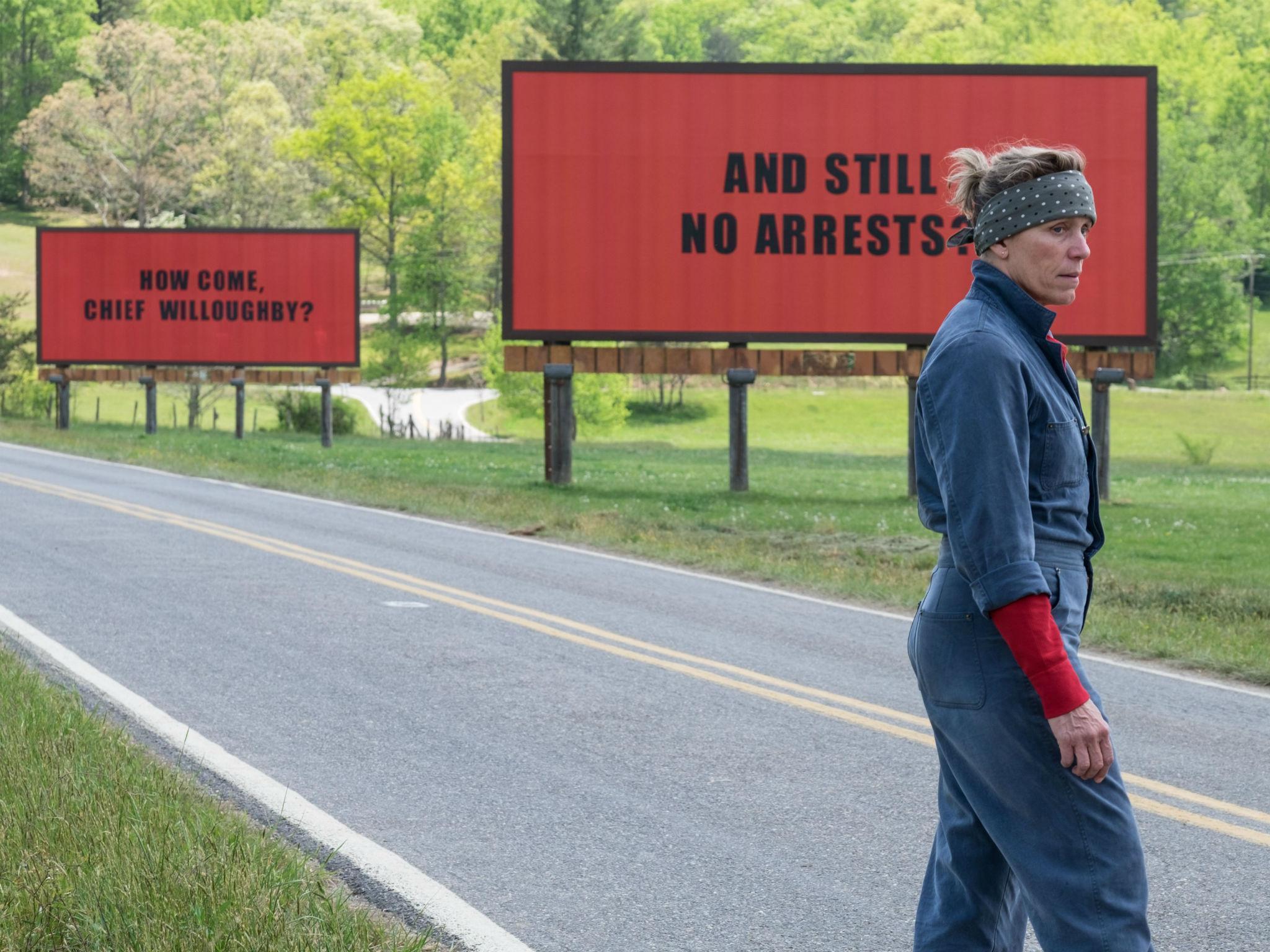
If Hannah Arendt can coin the ‘banality of evil’ then someone must have claimed the buffoonery of evil, even if only to refer to characters sprung from the mind of Martin McDonough. If you’re familiar with the director’s previous work, you’ll know what I mean. In Bruges the director introduced us to two squabbling hitmen as they grew bored on a European getaway. Seven Psychopaths featured a sextuplet of amoral thieves and killers repeatedly undone by their own stupidity. Now his latest film; Three Billboards outside Ebbing, Missouri tackles a police force rife with incompetence and violent misconduct.
One of
the few genuinely great working-class stories to emerge in the last few years, Three Billboards…centres on Mildred
Hayes (Frances McDormand), a bereaved single mother who hires the titular
billboards to chastise the local police force. Singling out Police Chief Bill
Willoughby (Woody Harrelson) for failing to catch the man who raped and
murdered her daughter. In Mildred’s eyes the local police are ‘too busy
torturing black folk’ to solve the case. Said torturer being his loyal lapdog
Officer Jason Dixon, whose crimes Willoughby nervously dismisses.
Now, make
no mistake the film is very good. Funny, poignant and dark, with outstanding
performances from McDormand and Rockwell. Yet this is another instance of a
white director, using a white lead, to cover an issue which predominantly
affects people of colour. Early last year the American Public Health
Association published a report that found that Black and Hispanic males were
almost twice as likely to be killed by police force than their white
counterparts. While Mildred’s rage over her daughter’s death is legitimate it
pales in comparison to the 55% of black homicides that go unsolved in the US
every year. McDonough is a talented storyteller but his distance from the issue
inevitably leads him to belie it. Predominantly in the way he frames Willoughby
and Dixon.
Admittedly Harrelson can play Willoughby
as an authoritarian brute, bearing down on Mildred in an interrogation room,
delivering threats to ruin her life. All to quickly though the film will
undercut this performance with reminders of his humanity, his vulnerability. He
is introduced to us as a family man, he spends time with Mildred earnestly
insisting that he wants to find her daughter’s killer. And then there’s the
kicker, he has a terminal illness. It feels like at every step we’re encouraged
to sympathise with this spineless brute. A man who not only enables Dixon’s
crimes but lavishes praise on him. Honestly at times he feels like a character
from a different film. One that didn’t feel like it had so much to say about
systemic racism within the police.
/cdn.vox-cdn.com/uploads/chorus_image/image/58380967/billboards1.0.jpg)
The film takes a similar approach
to Dixon, easily the more reprehensible of the two. Painted by his history as a
violent and unrepentant racist, having previously tortured a black suspect
during interrogation. Yet we crucially never see any of this take place. The
only act of racial profiling he commits during the film’s timeline is the off-screen
arrest of Mildred’s friend played by Amanda Warren. When he actually shares
screen-time with two African American characters they both display open
contempt for him without concern for any reproach. Remember, that this is set in a country where
black children have been shot dead for playing with toy guns. Granted one of
these characters is the new police chief and seeing him toss Dixon to the kerb
is fully intended as a satisfying moment of catharsis. However, the ease with
which Clarke Peters’ character can take charge of a police department
supposedly mired in systemic racism one again betrays McDonough’s naivety on
the subject.
Despite what we are told about Officer Dixon his on-screen
characterisation, much like Willoughby’s, feels designed to undermine his
authority and engender sympathy. Members of the public freely insult him, he lives
at home with his mother and whenever confronted with his wrongdoing he fearfully
denies it. He’s a terrified dog ashamed to have soiled the carpet, but with no
capacity to clean it. In short, he’s a far cry from real-life officers like Brian
Encinia; the state trooper who violently apprehended Sandra Bland shortly
before she died in custody or former Officer Philip Braisford who shot a
suspect with an AR-15 as he begged for his life earlier this year. These are
officers who confidently committed violent acts and remain unapologetic about
it to this day. No provocation, no
denials and no remorse. That’s the kind of misconduct McDonough supposedly
seeks to comment upon and woefully fails at.
Now, I’m not saying I wanted
Three Billboards… to feature scenes of violence against African Americans. In
case it’s not clear I see enough of that on the news. And yes, we should afford
McDonough some artistic license to deviate from reality. After all, no one was
expecting him to remake Serpico. It’s
only natural that characters like Willoughby and Dixon should warrant fleshing-out,
even humanising. But comparing these two goofballs to the actual cases of
police misconduct rings not of humanizing them, but romanticising. Comical
romanisation to be sure, on par with say, McDonough making a version of Spotlight where the priests acted like
Pepe Le Pew. But making lazy, corrupt and violent cops the butt of the joke is
a long way off examining the incendiary issure here. In doing so McDonough
blurs the reality behind the devastation these corrupt institutions wreak on
communities. Mischaracterising both the officers responsible and the issue Three Billboards… seeks to shine a light
on.
Saturday, 10 February 2018
Molly's Game

Not to get too personal but I run hot and cold on Aarron Soarkin as a writer. He's an obvious talent, writing slick, hyper-articulate characters who nonetheless feel like real and believable people. But at the same time he's obviously writing these characters from the limitations of a white male, establishment perspective. That's not a bad thing, it's worked like gangbusters when turned on the elitism of Harvard or the egotism of Silicon Valley. Hell, I've only seen about 1.5 episodes of the West Wing and yeah, Soarkin really nails his idealised vision of an intellectually-driven White House (it was a more innocent time). Pretty much anything bad I have to say about him comes from Newsroom where it really feels like Soarkin's worst instincts were allowed to flourish. All the female characters are, to varying degrees, painted as ditzy drama queens. The 'recent history' gimmick makes the whole thing feel dated and, on occasion, exploitative of real events. And the show is slathered in Soarkin's saccharin self-righteousness surrounding the wholesome integrity of the honest 'objective' news media.
I bring all of this up because Molly's Game, Soarkin's directorial debut, showcases him at both his very best and his very worst. Soarkin's almost supernatural ability to wring compelling drama out of the self-inflicted issues facing very privileged people is still very much present. As Molly Bloom, Jessica Chastain gives a nuanced portrayal of a self-made entrepreneur with all the drives and vulnerabilities of a believable human being. The film starts with Molly at her lowest moment, a crippling accident that ruins her career as an Olympic skier. Set adrift from her life's dream she takes a year out in L.A. and gets a job assisting a sleazy businessman running his high stakes poker game. With nothing but her wit and ability to make connections she quickly takes over the game, attracting bigger players and higher stakes. She takes control but her control is always a fragile thing, repeatedly endangered by the egos of insecure men and the interference of less than reputable gangs.
This is all told after the fact by Molly as both narration from her book and information relayed to Molly's lawyer Charlie Jafferty, played by the ever-admirable Idris Elba. In typical Soarkin fashion we find ourselves flitting back and forth through Molly's timeline. But unlike the experienced directors who previously handled his work Soarkin is unable to properly provide a coherent rhythm to his storytelling. Just when Molly is getting into her first poker game we suddenly flit back to her childhood, everything builds to Molly's court hearing in the third act but all the big emotional courtroom performance comes about twenty-minutes earlier. For the most part Soarkin's direction is solid, the man's crafted enough walk-and-talk scenes to know how to shoot one. It's surprising that for such a talented writer, the let down would be in the storytelling.

That's not to suggest his usual bad habits aren't on display her. With Chastain at the driving seat Molly is indeed a formidable creature; intelligent, driven and charming. All too often though her flaws come not from herself but from the judgement of the men around her. Jafferty frequently puts her down, undermines her and outright talks over her in one of the most Soarkiny of Soarkin's monologues. Worse still all her ambition, her drive for control, is written off as Daddy issues, patronizingly explained by her father, played by Kevin Costner. It's as if Soarkin goes out of his way to build a great character, only to tear her down.
What makes these scenes worse is that, while the dialogue is still sharp, Soarkin's speechifying inevitably gets the better of him. So much so that any real emotion that might have come from a heartfelt family reunion or a defiant statement of principle gets lost in a whirlwind of verbosity and literature references. It doesn't help that at no point do we empathise with Molly's unwillingness to rat out her players. All of whom are presented as leches, liars or outright sociopaths. Pride comes from a lot of places, but not protecting the people who sell you down the river.
This is not to say the film is without merit. Chastain practically carries the thing with nothing but her charm and vulnerability. Seeing her maneuver around Hollywood stars, Wall Street fat cats and Russsian Oligarch is the fun, goofy look at excess wealth that's impossible to dislike. But it all builds to such an anticlimax that it inevitably disappoints. One for Soarkin completionists only.
Thursday, 5 October 2017
My Problem with Guardians of the Galaxy Volume 2
Video Essayist Lindsey Ellis recently released a video titled ‘The Complex Feels of Guardians V.2’. In in Ellis sharply articulates the emotional depth of the film’s ending and why it, unlike many Marvel movies, had such a profound, personal impact on her. Ellis is not alone however, judging by the critical and commercial success of Guardians Vol. 2 and the sheer number of people claiming to have left theatres in tears. I’ve made no secret of mentioning on the podcast that this is not a sentiment I share, which I honestly feel says more about me than the film. I’m in the minority, having liked Guardians Vol. 2 well enough but not thinking it’s the superior of its predecessor. When I first viewed the ending it was emotional to be sure, but to my mind it was flawed in much of the same way the rest of the film was flawed (Spoilers follow obviously).
At the end of the film Ego the Living Planet is destroyed. Peter is left on a collapsing world but at the last minute is rescued by Yondu, his surrogate father. At they leave the atmosphere Yondu, with only one spacesuit, forces the suit on Peter. Sacrificing himself to save Peter’s life. There is Yondu’s devastating death scene, then a eulogy delivered by Peter before the body is cremated, then each character reflects on the films events to Cat Stevens’ ‘Father & Son’. Finally, as Yondu’s ashes float into space the various members of Yondu’s Ravager family arrive and bid him farewell, each with a single line. The film ends with a glorious firework display as tribute to Yondu’s life.
At the time I, perhaps callously, felt like this was an excessive amount of screen time to dedicate to a character who had only ever played a supporting role in the series. Over the years I’ve witnessed many dramatic deaths and subsequent tributes impact far better with more brevity. Only a few weeks earlier I witnessed the Death of Hugh Jackman’s Logan, a character I have known for seventeen years, executed in a few minutes. What I did not realise until watching Ellis’s video was that Yondu’s farewell wasn’t really about Yondu, it was about Peter. Peter is a character defined by immaturity. He lives life in a carefree manner, refuses to acknowledge the reality of his life on Earth and preserves the archaic pop culture of his childhood. Even in Yondu’s eulogy he uses David Hassehoff to contrast his idealised father with the man he now truly considers his dad. In that scene though Peter makes a few big steps away from an overgrown 12-year-old playing space pirates to a whole and mature person. The fireworks are not just in celebration of Yondu’s life but of Peter’s growth in reaching this point.
When reflected on this is the obvious interpretation. At the time though I wasn’t in a position to make the obvious interpretation. At the time I expected Guardians of the Galaxy Volume 2 to just keep on giving me too much. Too much comedy, too much emotion, too much science fiction weirdness. And not the good kind of excess either, the kind that only serves to undermine the film. Make no mistake Guardians Vol. 2 has everything you loved about the first Guardians just frequently cranked up to an obnoxious degree. This excess consistently ruins many of the films best moments and left me too soured to appreciate the ending by the time it came. It might help to provide a few examples of where this occurs so let’s start with the thing many people like most about the series; the comedy.
Several of the jokes in Guardians Vol. 2 are built off incredibly funny ideas that are overdone in their execution. The first example that comes to mind is the fight with Abilisk in the beginning (and no, I’m not talking about the full-length Baby Groot sequence, that was awesome). The joke comes when Drax decides he can only kill the Abilisk by leaping into it’s mouth. It doesn’t work and instead he spends the fight uselessly stabbing its stomach while Peter and Gamora work together to destroy it. When they do, Drax bursts out of its stomach, laughing and cheering triumphantly, believing he’s single-handedly vanquished the beast. Which he then undercuts by declaring “I have single-handedly vanquished the beast!”. Now I recognise the need to punctuate the joke but there are ways to do this without straight-up explaining the premise of the joke. Hell, if Drax just said ‘You’re welcome’ it would’ve worked just as well.
Roughly twenty minutes later we get another example of this, even as the creative team clearly works hard to follow the basic rules of storytelling. In executing a story point, particularly a comedic one, there’s something called The Rule of Three; introduction, build up and finally payoff. This occurs when Nebula, Gamora’s rogue sister, is taken prisoner on the Guardians’ ship. She’s hungry so tries to grab some fruit which Gamora keeps away saying ‘it’s not ripe…’, that’s our introduction. The build-up comes during the fight with the Sovereign, in the confusion Nebula again tries to grab the fruit, this time Drax knocks it away, reminding us of its cruel lack of ripe. The payoff is then complete when Nebula gains the upper hand and rubs her victory in our faces by eating the fruit and...it’s not ripe. Disgusted, she winces and spits it out and declares ’It’s not ripe.’ once again over-punctuating a joke with information we already know. The reason this, to me, doesn’t work is because the punchline is not that the fruit is unripe. We know the fruit isn’t ripe. The punchline is that Nebula’s stubbornness has brought an unpleasant experience, undermining what should be a moment of badassery. Instead the only thing the line undermines is the joke itself.
Now this isn’t true of every joke in the film (I’m Mary Poppins y’all!) but it is true of enough of them. From the extended, ostentatious laughter at the name ‘Taserface’ to the cartoonish level of disgust Drax holds for Mantis. And yes I am using ‘cartoonish’ to negatively describe a film in which one of the main characters is a walking houseplant. See, comedy is often cartoonish and outlandish and unrepresentative of reality. However at it’s best comedy does occupies an internal reality in which the character’s behaviour is consistent. We don’t believe that the Ancient Romans really behaved as portrayed in Monty Python and the Life of Brian but we do believe that’s the way the characters in the film’s world behave. When Guardians forces its characters to behave inconsistently for the sake of comedy it reminds us that these are not remarks that the characters would come to organically. They are lines in a script to be performed by actors on a set.
If this only occurred during the films comedic moments it wouldn’t be too awful. However we see the same on-the-nose writing during the films big, emotional beats too. Guardians of the Galaxy Vol. 2 really deserves praise for the amount of emotional weight it’s cramming into a goofy, summer blockbuster. Peter’s discovery of the father he never knew. Gamora and Nebula reconciling their mutual abuse at the hands of Thanos. And Rocket finally confronting the fact that he’s pushing away the only family he’s known out of fear that they’ll abandon him. However, this is also ruined by the film attempting to force the core engagement of these moments.
When Ego first begins teaching Peter how to use his powers he has him summon a ball of energy that they then pass to each other. Endearing himself to his son by affecting the fatherhood tradition of playing catch. On its own this is a very contrived moment, Ego’s actions are clearly deliberate and his motivations support this. However as he purposefully walks just far away enough for Peter to throw the ball the music swells with this big, orchestral beat. Transparently calling at it to recognise what an epic, emotional moment this is for Peter. Even though once again, we already know this.
There are other examples. Nebula and Gamora pitched fist fight ending with “You wanted to win and I just wanted a sister!” or Yondu forcing Rocket to acknowledge that he’s just like him. Character after character plainly saying how they feel and undercutting any emotional impact these statements might actually have. The most egregious though is at the end when Yondu saves Peter, declaring to him “He may have been your father but he wasn’t your Daddy.”. That moment made me stop. Throughout the entire film Michael Rooker has been acting his ass off, trying to hide the fact that Yondu cares for Peter. Letting it only slip just enough so that by the end of the film we know it, Yondu knows it and, in those final moments, Peter knows it.
I’m willing to accept this might be a personal thing. I’m pretty guarded even by British standards. But to me, emotions have the most impact when they’re arrived at organically. When characters don’t need to articulate them bluntly. When the music doesn’t have to give obvious clues to their presence. Going back to the catch scene, I think it would have worked much better if it was less obvious that Ego was setting up the whole thing. If he acted like he was really just trying to teach Peter to make a ball and it spontaneously became a game of catch from there. That might have given a better sense that Peter is genuinely endeared to Ego and thus might have some reservations about destroying him later. Instead, a lot of the emotional conflict that’s been slowly built-up is hand waved away in the final act because Peter’s motivation boils down to ‘I don’t care, he killed my Mom’.
This is probably the approach Gunn wanted to take though. As Ellis deftly explains sometimes an abusive parent can be forgiven, and sometimes they cannot. The moment reveals that he killed Peter’s mother Ego is officially beyond any sort of redemption. It’s just a shame that this sense of absolutism extends to Peter’s emotional development. Especially since a lot of victims of abusive parents never achieve this kind of moral certainty. At the end of the day this rush robbed Guardians of the Galaxy volume 2 of the emotional highs of its predecessor. Nothing in the film came close to the gentle tragedy of Groot’s Cocoon or the intensity of finally destroying Ronan.
Again though this is not to say that the film is not sweet, funny or heartfelt in places. As I said at the beginning, Guardians vol. 2 still has everything good about the first film. For most people it has more, for me it has less. But at least on re-examination I can say it’s gone up a few notches in my estimation. Thanks in no small part to the wisdom of Lindsey Ellis.
Friday, 26 May 2017
Ghost In the Shell: Erasure Steals its Identity.
Despite that title there's nothing that say a live-action Ghost in The Shell film featuring a predominantly white cast has to fail. Sure it's probably not what you want everyone talking about, but still. It's true that the original manga, and subsequent film, touched on very Japanese themes of identity and transhumanism. However as technology has evolved those very themes have come to encompass much of Western culture. Hell if we're being picky Cyberpunk only began as part of Western culture, with the debut of William Gibson's Neuromancer in 1984, a full five years ahead of Masume Shirow's manga. At it's heart Ghost in the Shell is a detective story and much of the cyberpunk aspect is set dressing inserted to realise the story's themes.
But while there's no obligation for this to be bad it apparently won't stop the creative team from trying. Taking an original idea about identity in a technological world and sucking it of all creative and thematic distinctiveness.
It's a film that's bad at pretty much every level. From the writing to the cinematography, the editing, fight choreography, set design. Frankly I wouldn't be surprised to lean if the on-set catering wasn't up to scratch. Worse still it tries to take the issues of white-washing and handwave it away with 2nd act revelations that neither serve as a consistent theme nor impact the character beyond this.
The plot is as good a place as any to start with. After opening with a faithful recreation of the original film's title sequence we awaken to discover Mira Killian. A victim of anseen terrorist attack, Mira's mind has been successfully transplanted into a top of the line, android body by the typically sinister Hanka Robotics. A year later she's a Major in Section 9, a counter-terrorist taskforce whose main case is taking down a notorious hacker named Kuse (changed from the animated film's 'Puppet Master because that would sound way too cool). While Kuse consistently seems to be one step ahead investigating him uncovers a conspiracy within Hanka that has ties to the Major's true origins, forcing the Major and Section 9 to go rogue under fire from the corporation itself.
Simple enough stuff. The only problem is that it wants to make a big deal about the Major's real identity and her reclaiming it, but only in the second act. It's almost as if they only noticed the big sore point of casting a Japanese property with a predominantly white cast and decided to insert the Mokoto identity at the last minute. Indeed in the beginning the Major seems to have no concerns about her true identity, or indeed any motivation that makes any kind of coherent sense. She defiantly declares her determination to track Kuse as being 'what she's built for' even though she and the audience know that isn't the case.
Incidentally this statement about Kuse has nothing to do with the line of dialogue she's responding to. Rather than have scenes play out organically GITS seems to just shove whatever it needs into individual scenes to communicate their respective emotions. At one point, fearing he's come to kill her, the Major refers to Bato as a 'Company Man', even though nothing about his character suggests this distinction. Seriously, the guy lazes about during briefings, drinks on the job and obviously maintains a healthy personal life. He's far better established as the 'Major's Man' even if he gets the short shrift in terms of story.
That lack of organic storytelling is what permeates through so much of Ghost in the Shell to render it hollow. Rather than build intricately designed sets with obvious dietetic function the set designers just slap a little neon tubing over modern day objects. Rather than arrange someone's office to reflect its owner's personality or the scene's tone it just shoves a bit of future tech into the background, regardless of functionality. The result is scenes which look empty. These aren't bars or offices, they're sets. These aren't conversations between two people, they're clunky lines of exposition from a script. And those aren't the (oddly deserted) streets of Japan, they're a CGI rendering dressed up with Anime artwork.
Save for the admirable efforts of the actors nothing about this film feels real. As with the original the action beats are just a pick and mix of the more iconic moments from the Manga. This time though the gaps between each beat offer little in the way of new information. Something desperately needed for this detective story. Images like the Geisha-bots, the invisible foot chase and the Tank battle just ring of fan-service. Ideas inserted into the film with no thought into how they should fit into an over arching story. Which just leaves the film feeling hollow and confused.
The Mokoto b-story only serves to clutter the already overlong A-story and changes nothing about the Major's character or informs her final descisions in the climax. A climax which, by the way, is utterly undermined by removing the weighty issues of transhumanism the original film dedicated ample time on. Reducing one of the greatest films of all time into just another empty action move.
Subscribe to:
Posts (Atom)